David Hockney: Lessons in Art
I was saddened by David Hockney's passing last week, although he certainly lived his nearly 89 years to the fullest. Seeing his David Hockney 25 retrospective in Paris was one of the highlights of 2025 for me. I have learned so much over the years from looking deeply at his work - about color, structure, and, most importantly, celebrating everyday beauty.
Here are just a few of the many things I learned from David Hockney.
We see subjectively
Hockney wrote a lot about how photography was valuable as an aide memoire, but had many limitations. A photograph can only capture a single instant in time, and a single point of view/perspective. Hockney experimented with photocollages to break up the single-point perspective of the world into dozens of different viewpoints. He saw this collage work as equivalent to drawing, because you have to decide how to combine the multiple images, how to add one moment in time on top of another.
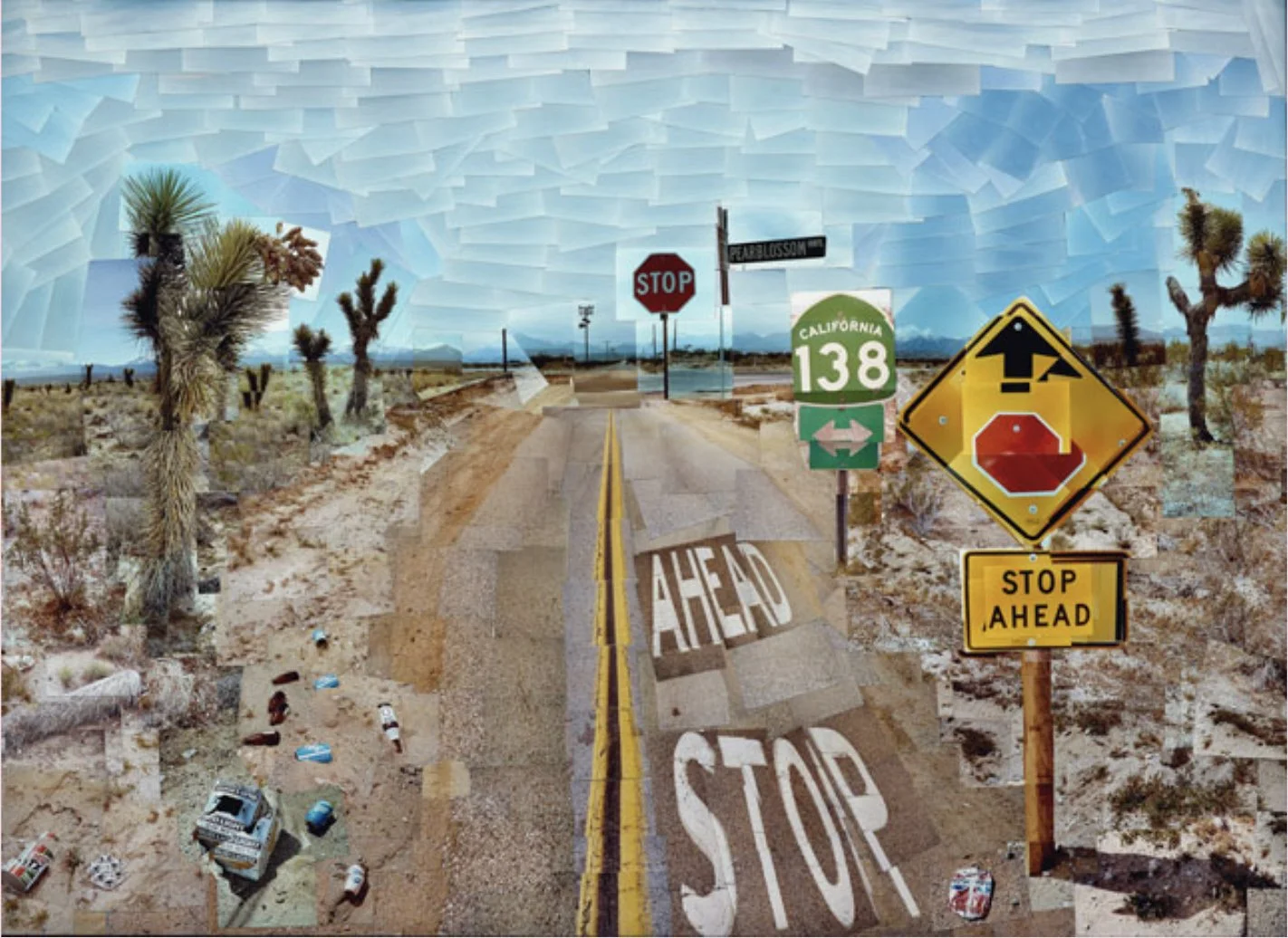
David Hockney, Pearblossom Highway, photographic collage, 47” x 64”
Beyond the single perspective limitation, photography was also sterile. It captured what was directly in front of it, but could not interpret it, or capture memories of what had come before, the way painting could. Hockney contended that we see everything through the prisms of our memories. "We see with memory. My memory is different from yours, so if we are both standing in the same place we’re not quite seeing the same thing. Whether you have been in a place before will affect you, and how well you know it. There’s no objective vision ever - ever." It is the artist’s ability to provide a subjective viewpoint that makes painting far superior to photography.
Hockney himself liked to quote Rodin, who famously said: “It is the artist who is truthful and it is photography which lies, for in reality time does not stop.”
Go big or go home
Hockney brought scale to landscape painting as no artist had done before. Frederick Edwin Church’s largest painting, Niagara Falls, was roughly 8 ft high by 7 ½ feet wide. Thomas Moran’s The Grand Canyon of the Yellowstone and The Chasm of the Colorado are each about 7 feet by 12 feet. While these canvases have always seemed monumental to me, particularly when standing in front of them, they are dwarfed by Hockney’s biggest painting, Bigger Trees Near Warter, which is roughly 15 by 40 feet.
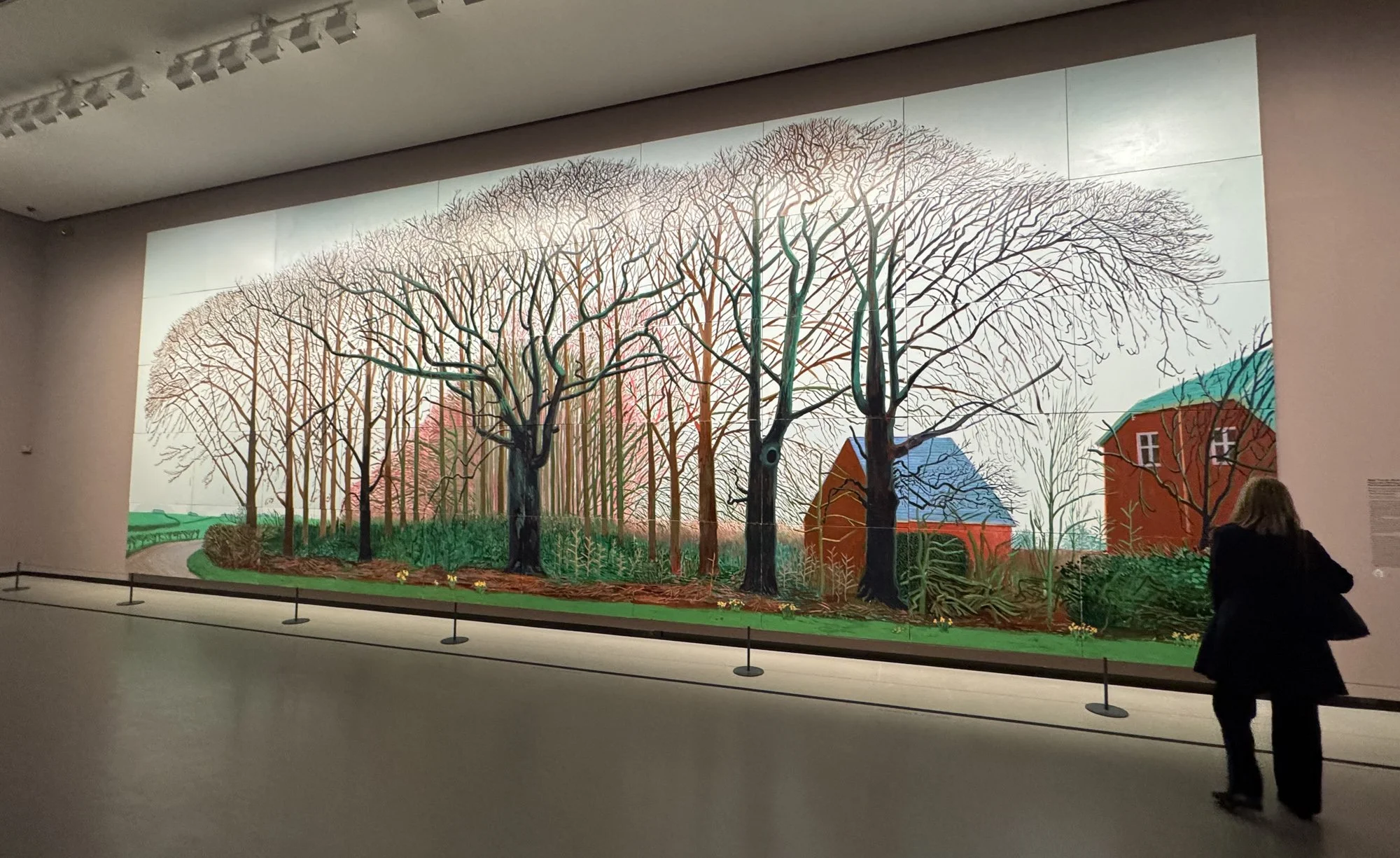
David Hockney, Bigger Trees Near Warter, roughly 15 by 40 feet.
A Bigger Grand Canyon, another favorite of mine, is composed of 60 separate canvases, with an overall size of almost 7 feet by 24 feet. I haven’t built up the courage (yet!) to paint on the multi-panel, massive scale that Hockney often did. I would need a much bigger studio to accommodate a painting that size. The biggest I’ve tackled so far is 48” x 60”. But Hockney pointed out that in comparison with the Grand Canyon itself the painting was, obviously, tiny. He also argued that photography could not do justice to the Grand Canyon, because it couldn’t capture the immensity of what we as humans see when standing on the precipice of the canyon. “A photograph sees it all at once, in one click of the lens, from a single point of view, but we don’t. And it’s the fact that it takes us time to see it that makes the space.” Hockney insisted that a painting was the only way for an artist to truly capture space.
Martin Gayford then asked Hockney how he set about painting space. Here’s the subsequent exchange, from the really fabulous book A Bigger Message: Conversations with David Hockney (also the source of the quote above):
Martin Gayford: So how do you set about painting space?
David Hockney: I don’t know, to be honest. I just do it by instinct. I don’t think there’s a formula. It’s something that can’t be measured, because it’s in the head. The eye is part of the mind.
Martin Gayford: If the eye is part of the mind, that implies that the space you see is partially inside the head of the artist.
David Hockney: I’ve always been fascinated by pictorial space, because you can just invent it and make it work. That’s what terrific artists do – Picasso certainly could.
Hockney painted on multiple canvases en plein air, not just in the studio. I believe the largest paintings he ever tackled outdoors involved seting up six canvases across three easels. He loved the physicality of sweeping his arms and brush across this huge expanse. When painting bigger than that, he had to paint in the studio.
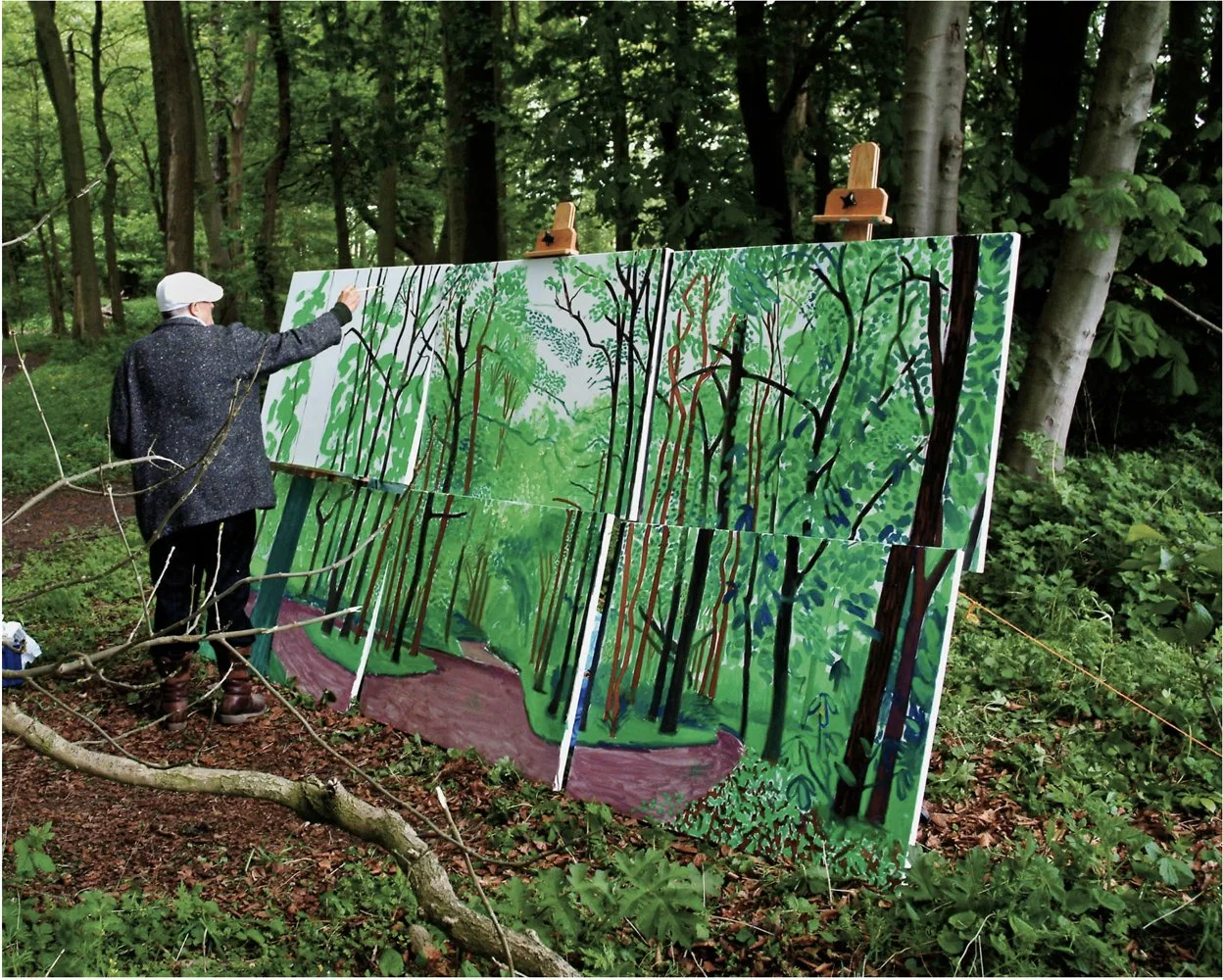
David Hockney painting a large-scale painting outdoors, across six panels and three easels.
Excellence requires obsessiveness to craft
When he was halfway through a painting, Hockney would often blow up an image of it and put it on his bedroom wall. He would fall asleep looking at the painting and wake up looking at it, in order to plan where to go next with the painting before he went to his studio. It was all part of his process of continual looking. I learned about this Hockney habit from a really fabulous podcast from 2012 featuring Edith Devaney, co-curator of the exhibit David Hockney RA: A Bigger Picture at the Royal Academy. The podcast provides so many gems about Hockney and his art – it’s well worth a listen, even if it is nearly 15 years old! https://podcasts.apple.com/us/podcast/david-hockney-a-bigger-picture-special-event/id510255139?i=1000111498633
Hockney was also said to have a note sitting on his bedside table that read: “Get up and get to work immediately.”
It’s OK to paint beauty
One of my favorite Hockney quotes: “The moment you cheat for the sake of beauty, you know you're an artist.” Hockney was enthralled with beauty, and he wasn’t afraid to paint “pretty” pictures. That earned him sneers from many a jaded art school student, but he didn’t care. He focused on being true to his vision, and to drawing and painting the beauty that spoke to him.
“The world is very, very beautiful if you look at it. But most people don’t look very much, do they?”
During his pandemic lockdown in Normandy, Hockney doubled down on beauty, focusing on capturing the spring that was bursting forth all around him through his iPad drawings. His famous quip from the time, as he sent forth his electronic messages of hope and joy: “Do remember they can’t cancel the spring.”
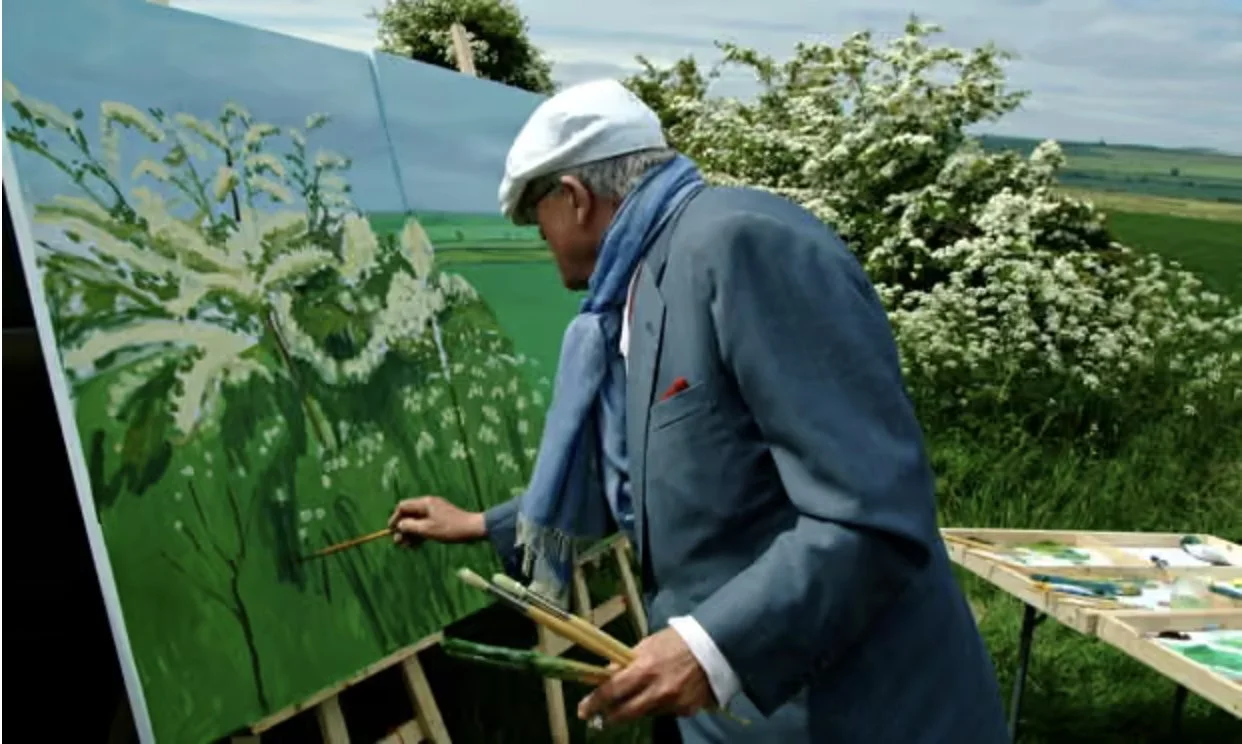
David Hockney painting en plein air in a suit. I love the photos of Hockney painting outside in Yorkshire in a suit and tie. There’s something so quintessentially British about this painting outfit.
Trees have personalities
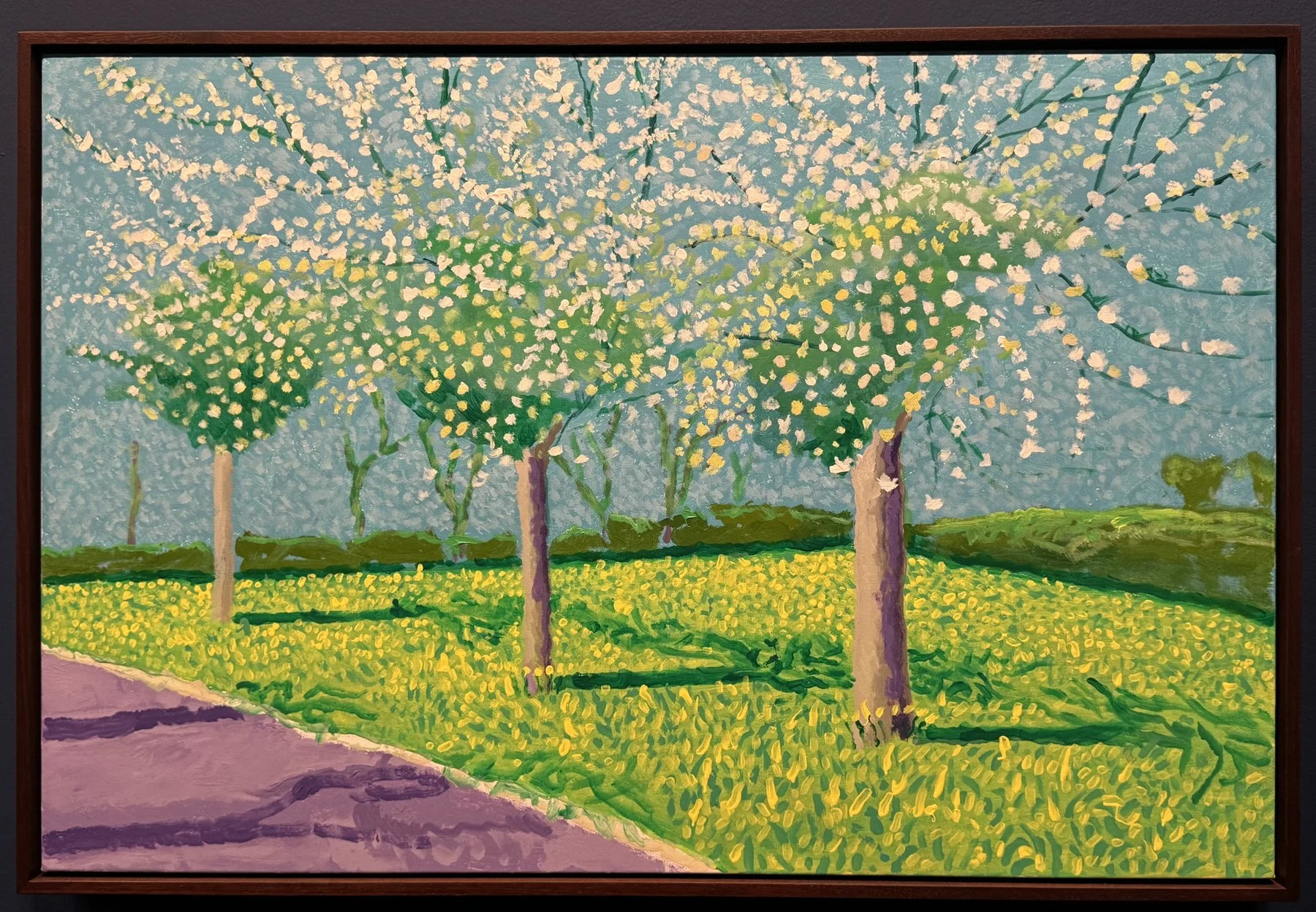
Cavid Hockney, Lots of Blossoms on Trees, 2023. Photo credit: Marcia Crumley
David Hockney taught me, and so many artists, to look at trees differently. (As did Van Gogh, who Hockney often cited as one of his artistic heroes. Van Gogh said that, in trees, “I see expression and a soul.”) Hockney was a close observer of trees, and loved to capture them in any season. While he loved the riotous colors of spring, he also loved the graphic quality of bare winter tree limbs.
Under Hockney’s loving gaze, trees take on an almost human form, mythical in their power. He once said: "Trees are human figures in the landscape." He captured individual trees’ personalities and strength and, under his skilled hands, even felled trees had something to say. Hockney’s painting depicts a winding rural road in Yorkshire, and a pile of felled trees along its right hand side. Often inspired by Yorkshire’s landscapes, he brings forth their vibrant colours and interesting shapes.He also rees become symbolic, almost mythic, but also colorful and playful, even when felled into stumps and chopped timber.
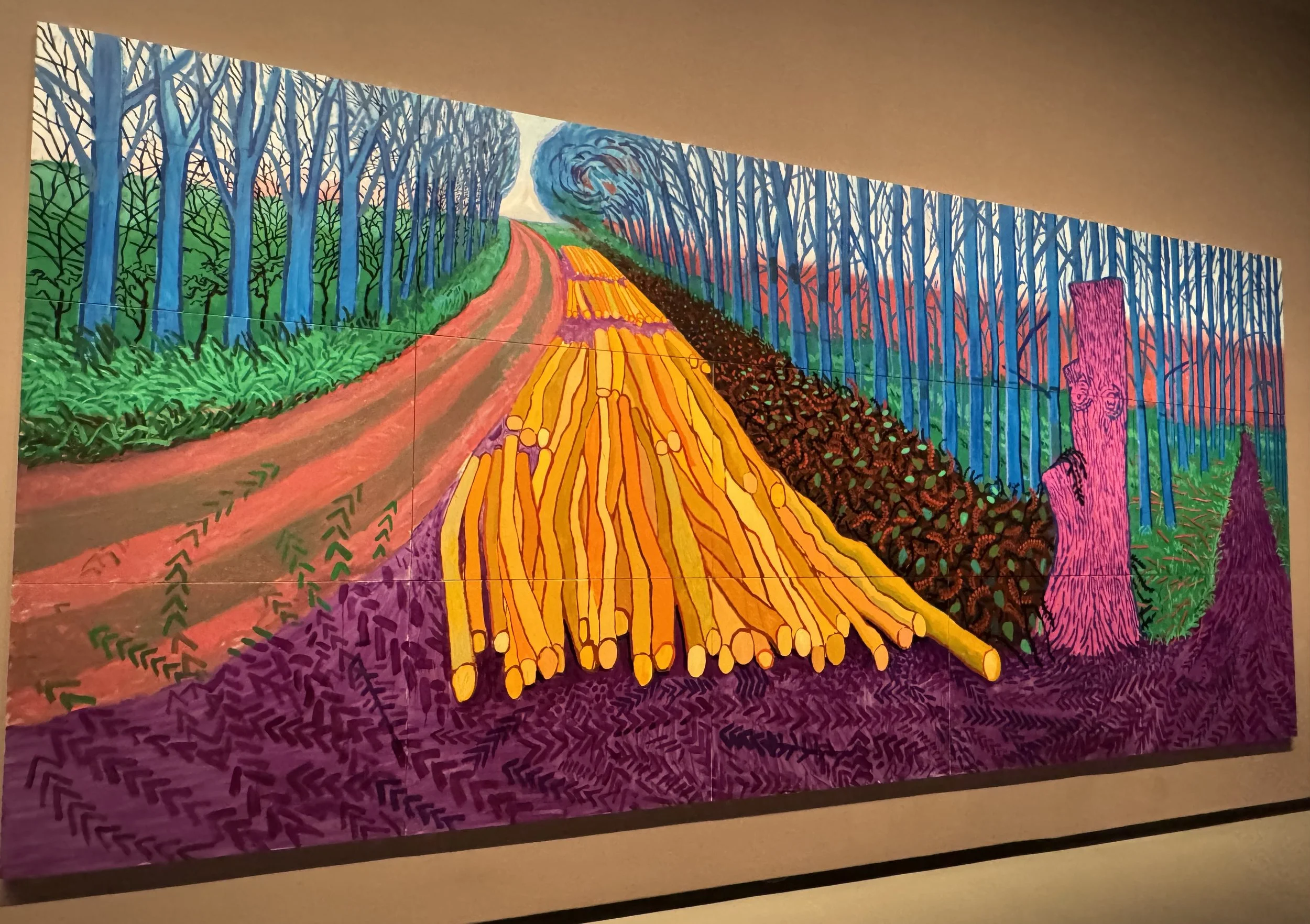
David Hockney, Winter Timber, 2009., roughly 9 feet by 24 feet, painted on 15 canvases. Hockney intentionally used two perspective systems—the road on the left and the line of logs on the right lead the eye differently, challenging traditional single-point perspective. The swirling blue vortex near the horizon is seen as a nod to Vincent van Gogh and his expressive treatment of trees and sky.
Layers are what make a painting
When a painter adds a layer of paint, they aren’t just adding more paint, but incorporating fresh thoughts and observations. It’s a similar process to that of writing - reflecting on what you’re already put down, editing and adding to it, continuously responding to what has come before.